The Australian Direction¹

A conference honoring² the mathematical contributions of Matt Emerton and Mark Kisin
(and a satellite of the 2026 International Congress of Mathematicians)

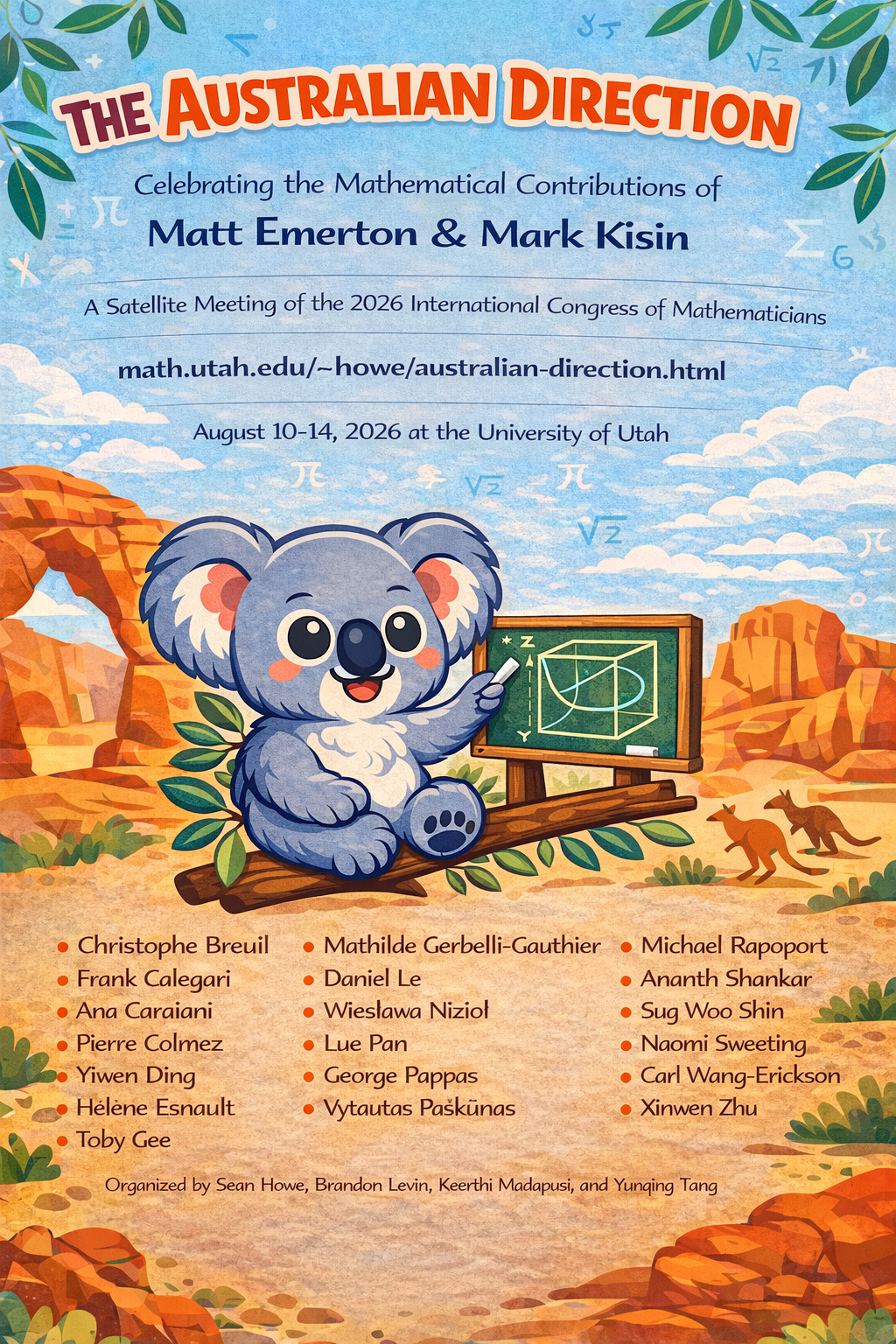
Conference poster
NSF logo
Supported in part by the National Science Foundation (#2609489)


Dates: August 10-14, 2026


Location: University of Utah Department of Mathematics, Salt Lake City, UT


Organizing committee: Sean Howe, Brandon Levin, Keerthi Madapusi, Yunqing Tang


Speakers: Christophe Breuil, Frank Calegari*, Ana Caraiani*, Pierre Colmez, Yiwen Ding, Hélène Esnault, Toby Gee, Mathilde Gerbelli-Gauthier, Daniel Le, Wiesława Nizioł, Lue Pan, George Pappas, Vytautas Pašku̅nas, Michael Rapoport, Ananth Shankar, Sug Woo Shin, Naomi Sweeting, Carl Wang-Erickson, Xinwen Zhu
*to be confirmed. virtual.


Schedule: We expect the conference to begin the morning of Monday, August 10th and to finish around noon on Friday, August 14th. There will be a free afternoon on the Wednesday and, in addition to the speakers listed above, we expect to hold two sessions of lightning talks and a poster session. Details TBA.


Registration: Registration form. Registration is open and free, but only registered participants may attend the conference.


Funding: If you are a graduate student or postdoc, you can apply for funding with the following link:

Funding application (Funding applications should be completed by May 3rd, 2026 for full consideration).

Note: We expect to be able to fund lodging in double-occupancy rooms for approximately 40 US-based graduate students / postdocs (US citizens/permanent residents based outside of the US are also eligible). However, we expect to have only limited funds available to support other travel expenses such as flights even for US participants; in particular, we encourage attendees to seek travel support from other sources such as their advisor or home university. Foreign participants are welcome to apply for funding, but unfortunately we expect to have only very limited funds available to support non-US students and postdocs.


Local logistics: The event will take place in the University Utah Department of Mathematics, in the JWB and LCB buildings on Presidents Circle. Salt Lake City International Airport is a major international airport and a Delta hub and there is a lightrail that goes from the airport to campus with a single transfer; in addition to a large selection of domestic flights, there are direct flights to/from Amsterdam, London, Paris, and Seoul. For participants looking to extend their trip, there are 7 major national parks³ located within five hours driving distance of Salt Lake City as well as many closer natural attractions. In particular, the University of Utah is nestled against the Wasatch mountains, and the Wasatch front affords abundant recreation opportunities at cooler temperatures a short drive from campus by going up Millcreek Canyon, Little and Big Cottonwood Canyons, and American Fork Canyon; most of the canyons are also accessible via public transit.


Lodging: The closest hotel to the event is the University Guest House; it is a 15-20 minute walk through campus to the math department (there are not many dining options near the guest house; however, there is a TRAX station very close by that makes it easy to get downtown for more choices). Another good option is the Little America Hotel, which is closer to downtown and well-connected to campus via public transport (TRAX or bus). There are also many options closer to the department through AirBnB/VRBO.


Footnotes:

¹In the study of the cohomology of algebraic varieties, there are two different "directions" in play: the "German direction," where one considers the coefficients of the equations defining an algebraic variety as varying in a family, and the "Australian direction," where one considers the coefficients of the cohomology theory itself as varying in a family. This terminology was introduced by Laurent Fargues [F] (in his talk at the 2015 summer algebraic geometry institute in Salt Lake City!) in the context of moduli of p-divisible groups to compare and contrast the moduli problems studied by Kisin with those studied by Rapoport and Zink. A broader comparison of these two directions has been emphasized, among other places, in Scholze's 2018 ICM talk [S], and has since grown into a useful dichotomy for understanding the many recent advances in the field, including the fundamental contributions of Emerton and Kisin. In this conference, we interpret the term "Australian direction" more expansively as including all areas of mathematics where the mathematicians Emerton and Kisin have made significant contributions.
[F] - Laurent Fargues. From local class field to the curve and vice versa. In Algebraic geometry: Salt Lake City 2015, volume 97.2 of Proc. Sympos. Pure Math., pages 181-198. Amer. Math. Soc., Providence, RI, 2018.
[S] - Peter Scholze. p-adic geometry. Proceedings of the ICM 2018.

²Matt and Mark, still spring chickens, are both turning 55 in 2026. But, together that makes 110! So, we're either a bit early or very late. And did you know that Benson Farb, perennial foil to Mark and Matt, even had a conference when he turned 50?

³Four of the national parks in Utah (Arches, Canyonlands, Capitol Reef, and Zion) can get quite hot in August, but Bryce Canyon is at a higher altitude and typically still nice. Grand Teton and Yellowstone in Idaho/Montana/Wyoming should be beautiful, though crowded. There are also many other nearby state parks and natural destinations that will be less crowded than national parks (we recommend, e.g., the Sawtooth mountains in Idaho).